Picture: STS 2030
Living wages are a key objective for sustainable textile supply chains. As part of the joint engagement “United for Fair Wages,” several companies and organizations are working together to achieve concrete progress.
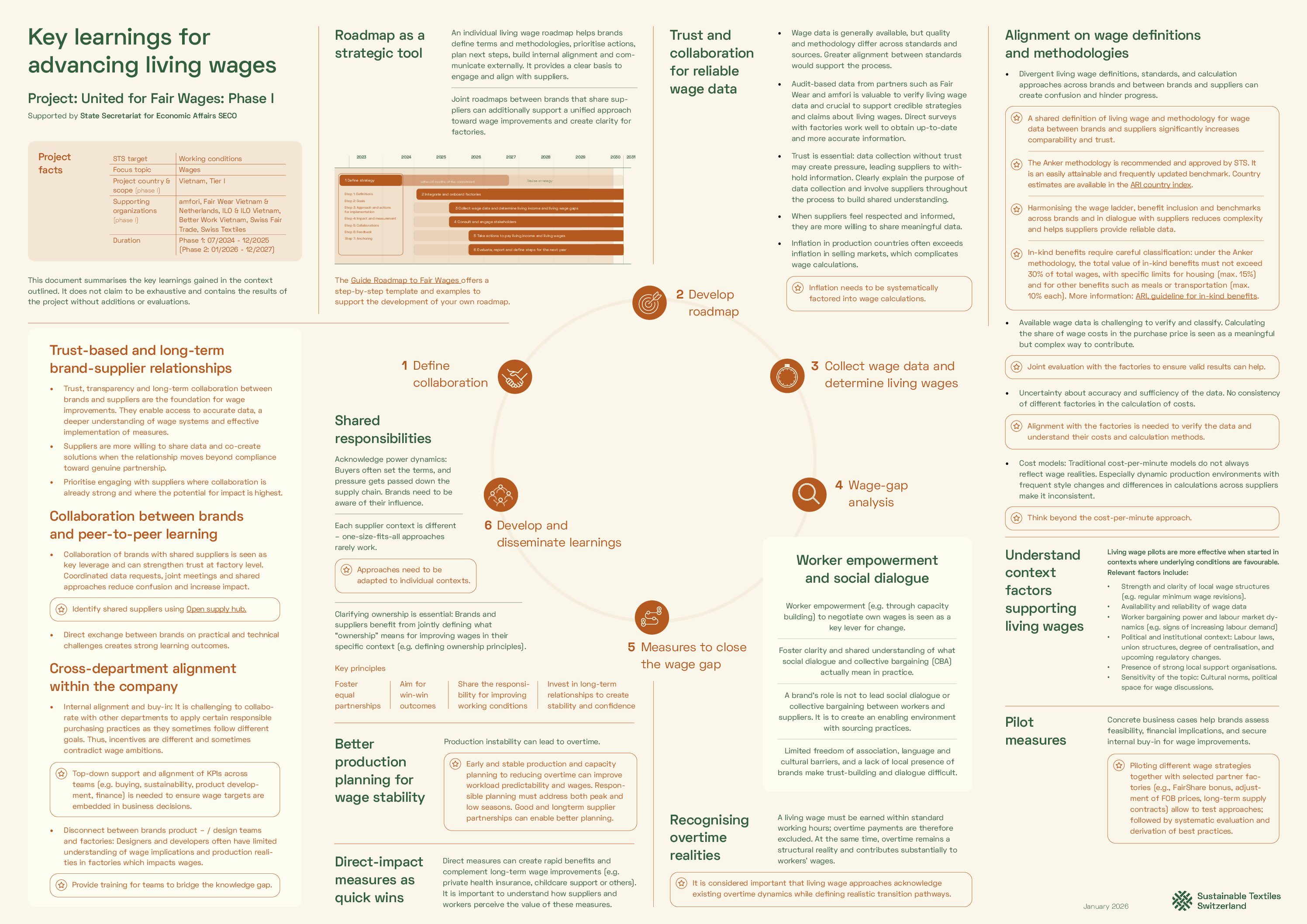
This pilot project initiated by STS focuses on Vietnam (Tier 1) in phase 1 (07/2024-12/2025) and is funded by the State Secretariat for Economic Affairs SECO. The focus is on cooperation between brands and suppliers. We are now sharing the most important findings for the first time, which can help all actors. Here is a brief overview:
- Trust and long-term cooperation are key
In cooperative relationships, suppliers are more willing to share reliable data and develop solutions together with brands.
- Roadmaps and jointly defined responsibilities create clarity
A clearly defined roadmap and coordinated responsibilities between brands and suppliers establish priorities, timelines, and next steps.
- Harmonization of definitions and methods are an important basis
Uniform terminology and a coordinated methodology for calculating living wages (e.g., the anchor method) increase comparability and transparency.
- Data quality requires trust and joint coordination
Audit data combined with direct factory surveys and joint validation by brands and suppliers provide a reliable basis.
- Operational implementation and pilot measures are necessary – plus systematic evaluation
Measures and improvements (e.g., production planning) should be tested and systematically evaluated together with partner factories.
- Internal coordination makes wage targets achievable
Buy-in and coordination between purchasing, product, finance, and sustainability are prerequisites for successful implementation.
- Consider the context
Local conditions, the labor market, and political structures influence feasibility and should be carefully considered.
- Peer Learning
Collaboration between brands with shared suppliers is considered an important lever for building trust at the factory level and promoting mutual learning. Lessons learned should be documented and disseminated to enable implementation and scaling.
From insights to impact
The first phase of the project clearly shows that the path to living wages requires clear strategies, trust, harmonized approaches, and close cooperation. For actors, participating in such joint initiatives offers the opportunity to benefit from collective knowledge, pool resources, and achieve greater impact together.
Following completion of phase 1 (end of 2025), a second phase is planned from January 2026 to December 2027 to deepen the insights gained and achieve further progress.
More information about the pilot project >
Learning (please click):