
Picture: STS 2030
Sustainable Textiles Switzerland 2030 (STS 2030) assesses the status of implementation of its program targets and measures on an annual basis. To this end, all actors committed to the program submit standardized reports on their current implementation status.
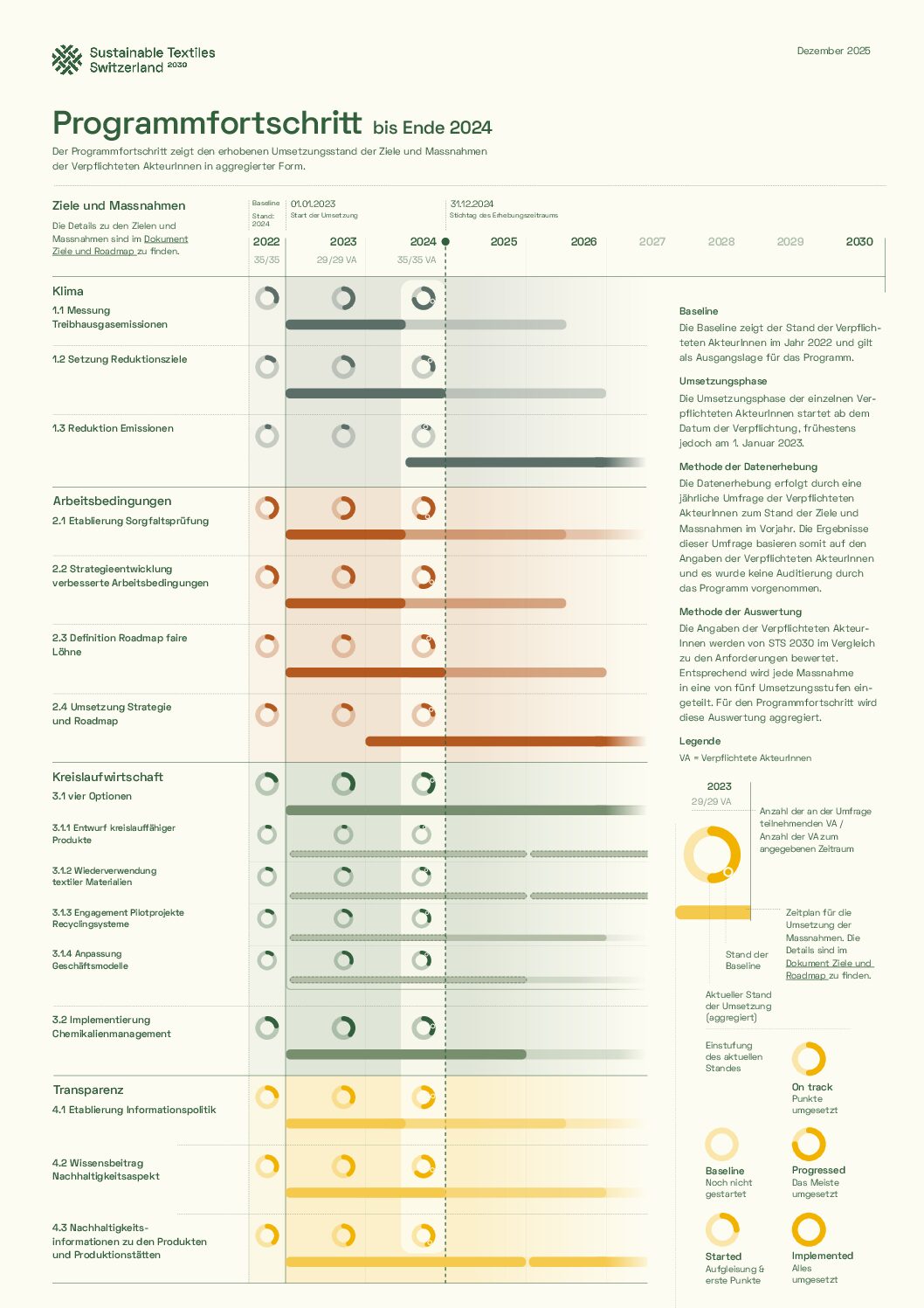
The second progress measurement records developments in 2024 and compares them with the program roadmap. The results are encouraging: overall progress in 2024 has almost doubled compared to the previous year. This illustrates the increasing momentum within the program – many actors have moved from the planning to the implementation phase, and the foundations for key measures have been laid. The high level of commitment is reflected in the full participation of all committed actors.
The foundations are laid
Progress was made in all four target areas last year, but particularly in those that serve as the foundation for the transformation: these measures form a central basis on which the next implementation steps can be built.
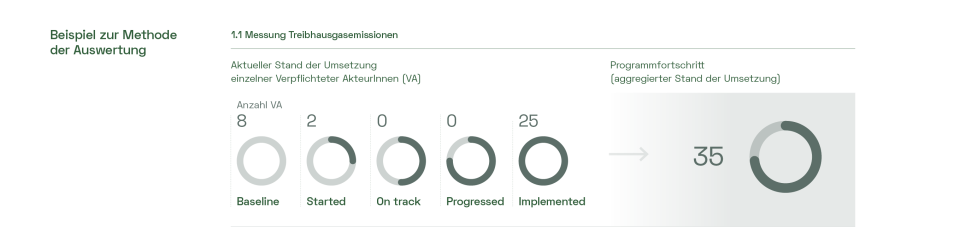
- Climate: Significant progress has been made in measuring greenhouse gas emissions (1.1), meaning that the majority of actors now have access to reliable data. This provides a solid basis for setting science-based reduction targets (1.2) and pursuing emission reductions (1.3).
- Working conditions: The process of establishing human rights due diligence (2.1) has already been implemented by many and is being continuously pursued. At the same time, the development of strategies for enhancing working conditions (2.2) has been particularly strongly promoted. This is a mandatory prerequisite for achieving the objectives in the entire area of working conditions.
- Transparency: Many actors actively communicate knowledge contributions on sustainability aspects (4.2) and professionalize their internal information systems. Overall, transparency is the most developed target area.
Ambitious targets are challenging
At the same time, progress measurements show that the schedule for achieving the program targets is ambitious. Where complexity is highest or structural barriers exist, delays in the schedule are evident:
- Lack of best practices: The creation of a roadmap for fair wages (2.3) is the area that has fallen furthest behind schedule. Not only is this target area complex in terms of content, but there has also been a lack of established, proven best practices across the industry. To facilitate implementation, pragmatic and economically compatible support measures were developed during the reporting year.
- Structural hurdle: Looking at the overall assessment, the measure relating to the design of recyclable products (3.1.1) has shown the least progress to date. The main challenge is that the existing systems and infrastructure for genuine textile recycling are not yet sufficiently developed. However, the options for pilot projects for recycling systems (3.1.3) and adaptation of business models (3.1.4) have shown significant progress since the program was launched.
Focus on cooperation and targeted support
The findings of the second progress assessment underscore the importance of commitment, cooperation, and targeted support in overcoming structural and thematic barriers. Regular exchanges of experience, supporting documents—such as guidelines and practical examples—and joint pilot projects within the framework of STS 2030 have proven to be effective approaches in this regard.
Given the current momentum and the identified hurdles, it will be crucial to continue driving implementation forward in 2025 in order to achieve the STS 2030 targets.
Detailed view of the results: